
A medical gas pipeline system (MGPS) is a system of medical gas pipelines with a central source that safely delivers medical gases and vacuum to various locations within a healthcare facility. They are typically found in hospitals and intensive care units (ICUs), operation theatres, emergency departments, recovery rooms, and other clinical settings.
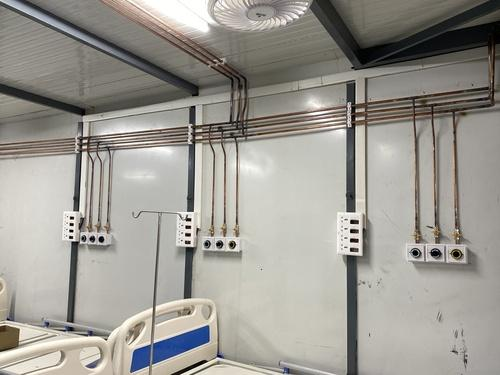
An MGPS provides gases via a specific pipeline system to gas-specific terminal outlets instead of individual gas cylinders at each patient location. The system may consist of the source of supply, medical grade piping, medical grade valves, medical grade pressure regulators, alarm systems, monitoring equipment and terminal units.
Medical gas pipeline systems refers to the medical gases pipeline systems which are covered by requirements of ISO 7396-1 for pipeline system design, installation, performance, testing, commissioning and documentation in compressed medical gases and vacuum.
How Does a Medical Gas Pipeline System Work
Medical gas pipeline system operates by transporting medical gases from the central point to the medical equipment/patient terminal outlets via dedicated pipelines.
Healthcare applications use a Terminal Outlet with a Terminal Valve to control the supply of medical gases. Terminal Outlet receives the medical gas supply from the Zone Valve via a Medical Gas Pipeline with an Alarm and Monitoring. The medical gas supply enters the system through a Pressure Regulation Module and then through a Central Gas Source.
Medical oxygen can be provided by a liquid oxygen storage system, oxygen generation plant or a cylinder manifold. The gas is then distributed via the distribution system and delivered to oxygen specific outlets to patient wards, ICUs and operating theatres.
Every medical gas is provided through its own distribution network and there are gas-specific connection points to reduce the risk of connection between service types and prevent errors.
 Get Quotation
 Call For Info
 Get Catalogue
| Specification | Details |
|---|---|
| System Type | Centralized Medical Gas Pipeline System (MGPS) |
| Pipeline Material | Medical-grade seamless copper tube |
| Copper Pipe Standards | EN 13348 / ASTM B819 |
| Copper Material | Cu-DHP / CW024A |
| Pipe Condition | Degreased, internally cleaned and capped |
| Jointing Method | Silver brazing / brazing with controlled inert-gas purge |
| Medical Gases | Oxygen (O₂), Nitrous Oxide (N₂O), Medical Air, Carbon Dioxide (CO₂), Nitrogen (N₂), Surgical Air and Vacuum |
Main Components of a Medical Gas Pipeline System
The medical gas pipeline system has multiple inter-connected components.
1. Central Gas Supply
The point of origin of the system is the central supply. The source can consist of:
- Oxygen storage systems
- Oxygen generation plants
- Cylinder manifolds
- Medical air compressors
- Vacuum pumps
- Gas storage systems
2. Medical Grade Copper Pipes
The medical gas pipelines are usually made of specially manufactured and cleaned copper tubes which are suitable for medical gas applications.
The pipe should be suitable for the specific service, and installed in accordance with the relevant project specification and standards.
For instance, medical copper tube products can be created to standards like ASTM B819 or EN 13348, as per project demands.
3. Copper Fittings
Pipeliners sections are joined together and turned at various angles with copper fittings. Common fittings include:
- Medical copper elbows
- Copper tees
- Couplings
- Reducers
- End caps
4. Valves and Zone Valve Boxes
Zone valves enable certain areas of the hospital to be isolated in case of maintenance or emergency.
May include valve arrangement for each area, including:
- ICU
- Operation theatre
- Emergency department
- General ward
- Recovery room
5. Alarm Systems
Alarm and monitoring systems are a key element of MGPS infrastructure. They are able to keep track of the conditions of supplies and provide warning to the staff of the hospital when something is not normal.
Requirements for monitoring and alarm systems in medical gas pipeline systems are addressed in particular in ISO 7396-1.
6. Terminal Units
The medical equipment connecting to the pipeline system is called a terminal unit.
They are mounted at sites like:
- Patient beds
- ICU bedhead panels
- Operation theatres
- Emergency rooms
- Recovery areas
- Medical treatment rooms
FAQ (Frequently Asked Questions)
What is a medical gas pipeline system?
A medical gas pipeline system (MGPS) is a centralized network that distributes medical gases and vacuum from supply sources to gas-specific terminal outlets throughout a healthcare facility.
What gases are supplied through MGPS?
Common services include oxygen, medical air, nitrous oxide and medical vacuum. Depending on the facility, carbon dioxide, surgical air, nitrogen and anaesthetic gas scavenging systems may also be included.